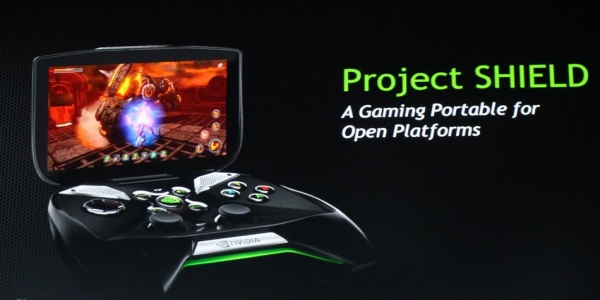
A few days ago Nvidia unveiled a new device to compete in the handheld gaming market code named Shield. The device is designed to lower the number of devices you need to carry with you to play games, the situation described was someone travelling somewhere with a gaming device and a controller. Project Shield is there so that you take only that device and no other extra pieces of kit.
Looking at the Shield from behind, you may mistake it for being just another controller; however the Shield is more than just a controller. It has a 5 inch 720p retinal multi-touch display enabling you to use the device’s ‘pure android’ operating system as you would a tablet or smart phone and boasts the ability to play Android games from the Play store, and to stream Steam games from your Nvidia toting gaming computer.
Im sure some of you will agree that the new handheld looks remarkably good with straight lines and angles, it looks like Nvidia went for a kind of stealthy design. The Shield has a removable plate on the rear of the screen so you can swap it to a design that suits your taste. I think is a nice feature from Nvidia to allow the user to replace the panel, instead of putting a sticker over it.
Nvidia Shield will be the first device to market with the world’s fastest mobile processor, the Tegra 4 which includes the first quad core ARM CPU core the Cortex-A15. The Tegra 4 has 72 custom GPU cores and as seen in the announcement can support a 4K screen effortlessly. The Shield has industry standard Input/Output ports allowing users to plop in a Micro SD card, connect it to your TV via its Mini HDMI and charge it using a Micro USB cable so you don’t need to carry more and more cables.
After doing further research into how the Shield will be able to stream games from your computer I noticed that you will only be able to use the feature if you have an NVIDIA Kepler - based GeForce GTX 650 (Desktop) or GTX 660M (Notebook) or higher. This means a huge amount of potential customers that were already limited by Nvidia cards will need to upgrade to have one of their latest range of graphics cards. To replace your graphics card to the GTX 650 the current price varies from £81 to £147 depending on a variety of factors.
I personally would love the Shield to sell well and fill the niche in the market that there is for a new multi-role device, but it may launch at a time where people have not got the latest graphics card in their computers. I have an Nvidia GTX 550Ti so am out of the picture for being able to use the “Steam stream” feature currently and would mean that buying the Shield would only be to play the Android games and the games purchasable from the Tegra Store. If the device sells at a competitive price point that allows some room for the Graphics Card upgrade then I would go out and buy one tomorrow, but pricing has not been revealed yet.
Compared to the other handheld devices available the Shield takes a new step by running an Android operating system and providing full sized console grade controls for the bigger games that look very similar to the Xbox 360 controller with the A,B,X and Y buttons. The console has less limiting features than the PS Vita and is set to have a much better launch line up from what we saw during CES 2013. The Shield’s bigger screen although non 3D competes with the 3DS’s front facing touch screen and by running on the Android operating system we could see more customizable applications by developers for the device.
In conclusion I believe that the Shield by Nvidia is definitely a device to watch over the coming months. Purely to see how the launch pans out and how much support it will receive from games developers, and also the PC gaming community. The main factor that I feel will limit the success of the device are the potential upgrades that people may need to do to their gaming computers for “Steam Stream” and the actual sale price of the device itself in stores once released.