
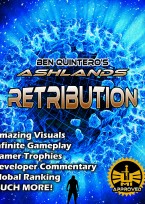
Spaceship shooters have seen a nice resurgence in recent years, thanks to great titles such as Geometry Wars: Retro Evolved and Super Stardust HD. The power of current hardware has allowed studios to take an age-old concept and bring it into the modern day, with colourful firework shows of explosions, lasers, and particle effects. The latest game in this new-but-old genre is Ashlands: Retribution, which arrived on the Xbox Live Indie Channel recently, thanks to the efforts of its creator, Ben Quintero.
Retribution is the tale of a man stranded on a desert world, after his craft was blown from the sky by enemy forces. Salvaging a derelict ship, he takes back to the skies on a quest for revenge. Let’s be honest, though, does the plot really matter in a game such as this? What matters is the action, which Ashlands doesn’t fail to deliver.

Anyone who’s played a twin-stick shooter will instantly understand the concept - the left stick moves your craft around and the right stick fires in whichever direction it’s pointed. In fact, players of Super Stardust HD may find things a little too familiar, as the visual style is almost identical in both games. Even the layout of the levels is the same, with your craft flying not on a flat plane, but around a spherical planet, meaning there are no edges to the playing field. One major difference, though, is the abundance of asteroids, which will slow your progress down as you struggle to clear a path while simultaneously avoiding the waves of enemies bearing down on you.
Of course, you have a few tricks up your sleeve. As you destroy objects, you’ll collect green orbs, which power up your special moves. There are four of them to utilise: Boost, which knocks out anything in your path; Overclock, which strengthens the power of your guns; Battle Armor, which provides a temporary shield; and Bomb, which destroys everything around you. Knowing when to use these moves is the key to surviving the increasingly difficult challenges you’ll face. Unfortunately, since your special bar is reset whenever you lose a life, you may find that one death quickly leads to another. After all, if you couldn’t handle yourself on the battlefield with all your power moves charged up, things are going to be even tougher when you respawn with nothing.

Thankfully, your demise need never be in vain, as each attempt gains you valuable XP, which can be spent on Augmentations - upgrades to your ship, weapons, and special moves. This is the aspect that helps keep Retribution’s sometimes-frustrating difficulty from becoming too much to bear. Your current level and all your upgrades are persistent from one play to the next, so with each attempt you’ll get a little further than you did the last time. In fact, I didn’t really start having fun with the game until I’d acquired a few of these upgrades, bringing my ship’s speed and weapon power up to the point where I could survive for more than a couple of minutes.
Aside from the main Conquest, hardcore shooter fans can test their skill in other modes, which challenge you to survive endless waves of enemies. There are no level breaks or bosses to fight (except in Boss Rush mode, of course), just wave after wave of ships to shoot down and asteroids to blow up. There’s even a too-tough-for-me Realism mode, in which you must stay afloat with only one life - lose it, and it’s game over. Nice idea, but just not something for me.

When it comes down to it, though, all of the different game types are really just about one thing - getting a high score. That’s the point of most modern spaceship shooters, and it’s certainly the point of this one. The story, experience points, and augmentations may set Retribution apart from some of its peers, but the main focus is the same as all the others - beating your friends, knocking them down the leaderboard, and lording it over them. I’m not really a competitive person, but the thrill of one-upping another at a video game is something I greatly enjoy, and I’m sure I’m not alone. It seems, though, that online leaderboards are not allowed on the Xbox Indie Games Channel, so instead you’ll have to upload your scores to the Inland Studios website, by means of a QR code displayed in-game. It’s a little inconvenient, but I suppose its the best we could hope for.
So overall, I’ve had fun playing Ashlands Retribution. It’s not the best in the genre, but very impressive for a title that was made almost entirely by one person. It can certainly get frustrating at times, but I suppose that can be said of any title that provides a little challenge. I’m still not sure if the Xbox Indie Channel is going to amount to much, but thanks to games such as this, I have a little more hope than before.
Check out Masonic Gamer Podcast Episode 1 to hear our interview with Ben Quintero.